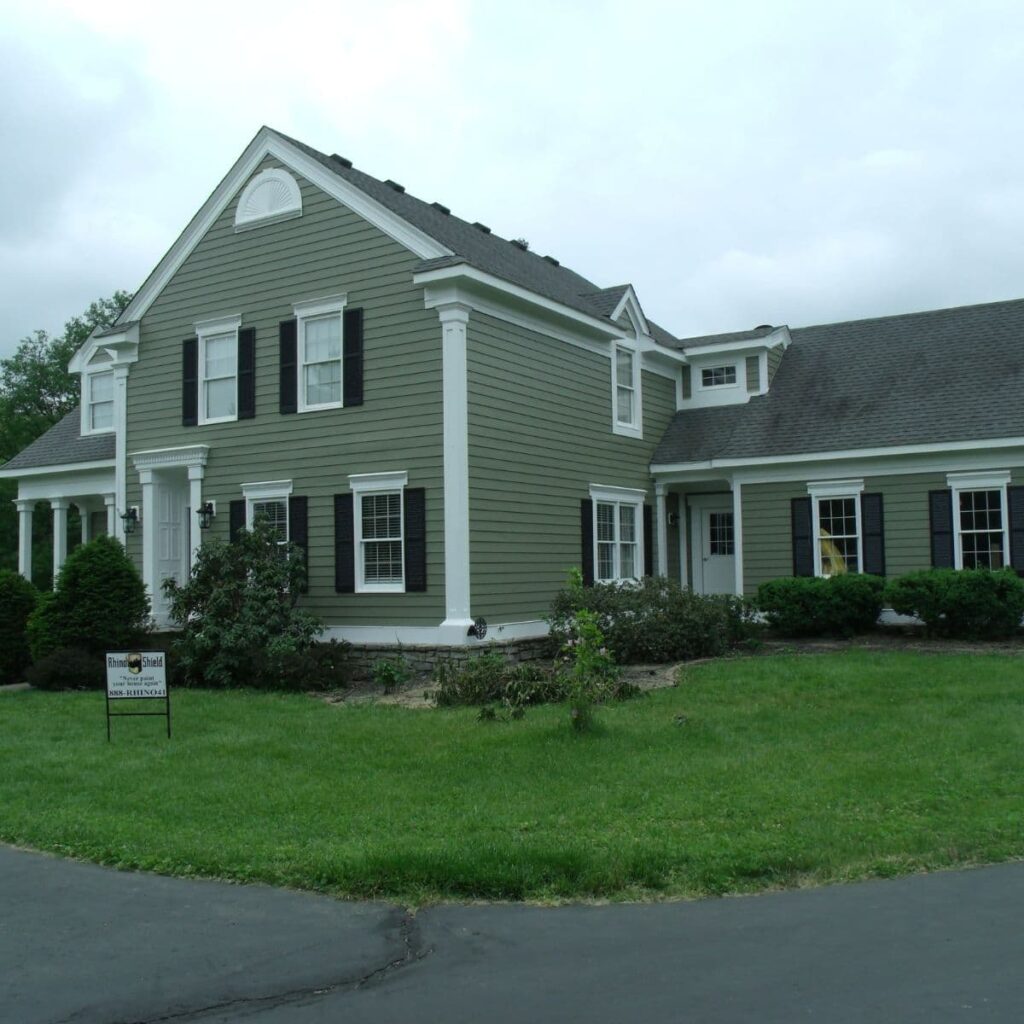
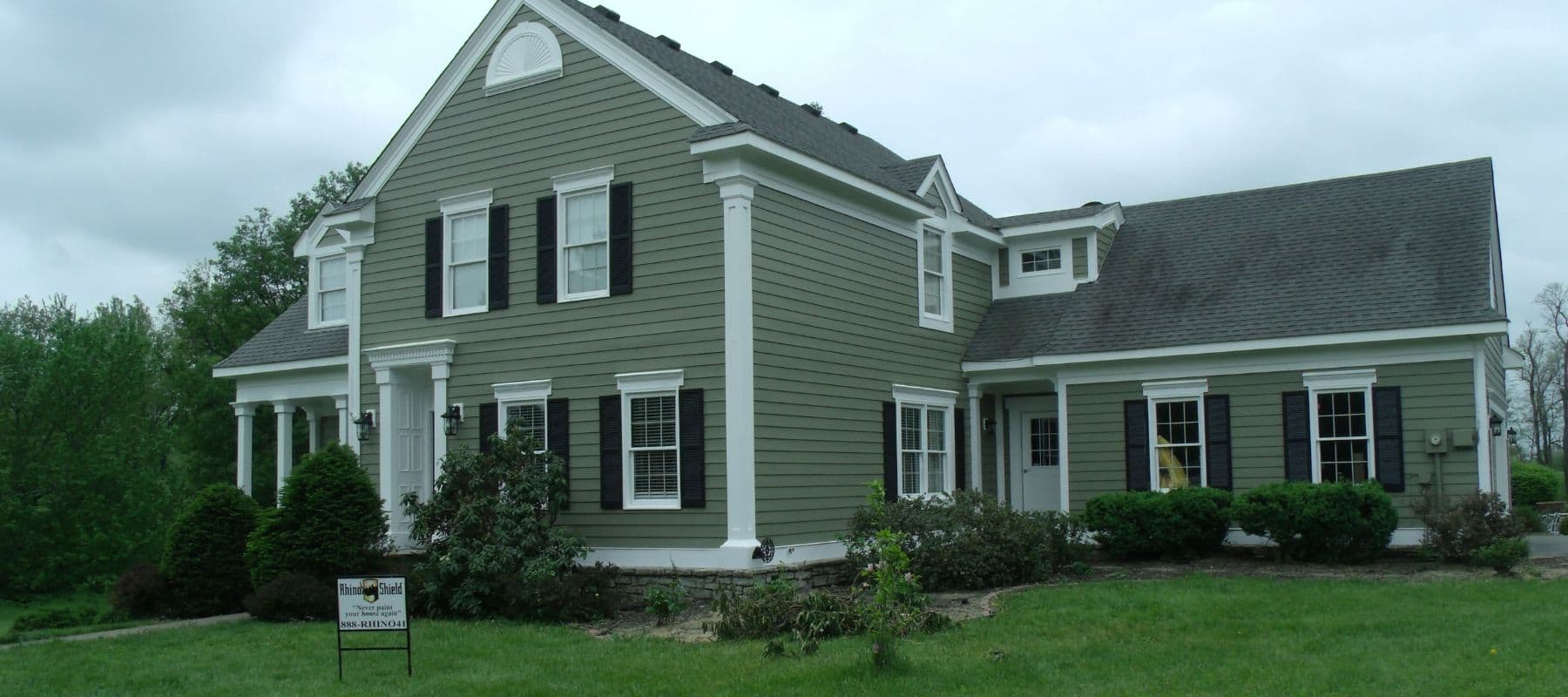
The factory enamel breaks down under years of UV and releases its pigment as a fine powder, which is why it rubs off on your hand. Washing does not bring the color back. Once that chalk is fully removed and a bonding primer goes on, aluminum takes a new coating very well, which is why coating beats re-siding on most sound walls.
Run your hand across an older aluminum wall. If it comes away dusty or discolored, you already know something is wrong even without a name for it. That chalky residue is not dirt on the surface. It is the factory-baked enamel breaking down.
Aluminum siding’s original finish is a baked enamel, and like any painted surface it takes UV damage year after year. Eventually the binder holding the pigment together degrades and releases that pigment as a fine powder. That is chalking, and it is the most common reason we get a call about aluminum. It shows first as a dulled, flattened color, then as light powder on a hand, then as visible transfer onto dark clothing. Those three stages tell us how far the oxidation has gone, and they are the first thing we check on an estimate.
Pressure washing alone does not fix it. It removes loose dirt, but the chalking is happening within the finish rather than on top of it, so a rinse leaves the same dead color behind. The chalk has to come off completely, or the new coating bonds to loose powder instead of the panel.
Worth knowing about the housing stock: most aluminum-sided homes here went up between the 1950s and the 1970s. That usually means two or three repaints already layered over the original enamel, and often original wood siding underneath it all.
For more on how UV degrades exterior finishes, see why exterior color fades. If the category is new to you, here is what ceramic coating actually is.
Not sure how far gone your finish is? We will tell you at the estimate.
If your aluminum is chalky, faded, or dated-looking, a vinyl re-siding quote is probably already sitting in your inbox. Worth comparing both paths honestly before you decide.
| Coating Existing Aluminum | Re-Siding In Vinyl | |
|---|---|---|
| Upfront cost | A fraction of full re-siding | Full material and labor cost |
| Disruption | Exterior coating work only | Full tear-off and new siding installation |
| Timeline | Typically 3-5 days | Often 1-2 weeks or more |
| Waste and disposal | None, existing panels stay on the wall | Full tear-off hauled to landfill |
| What happens underneath | Nothing disturbed | Sheathing and any original wood exposed during tear-off |
| Expected life | One application, no repaint cycle | New product life |
| Warranty | 25-year warranty on the coating | Manufacturer warranty on panels, installer labor warranty separate |
Most aluminum-sided homes we look at are structurally sound. The panels have not failed. The finish has. That is exactly the situation a coating is built for.
Some of these homes have weathered down to bare aluminum in patches, and owners almost always read that as the point of no return. It is closer to the opposite. Bare aluminum, properly primed, is a better substrate to work with than a half-chalked painted one, because there is nothing loose in the way.
Re-siding genuinely is the right call in some cases: panels corroded through, extensive impact damage, or a wall assembly problem behind the siding that needs addressing first. We will tell you plainly at the estimate which situation your home is in. See vinyl siding painting if coating vinyl is more relevant to your project.
Fading and chalking are the same process at two stages. UV breaks down the enamel binder over years, the color dulls first, and eventually the surface releases dead pigment as powder. South and west walls show it earliest, which is why one elevation often looks a full shade lighter than the rest of the house. Once transfer onto clothing starts, the finish has given up its surface and washing will not bring it back.
Aluminum does not rust the way steel does, but it oxidizes and pits, particularly where the factory finish has worn through or where moisture sits against the panel. Pitting concentrates in predictable places: bottom edges of panels, beneath downspouts, and anywhere trim traps water. Left alone it roughens the panel and makes it harder for a new finish to bond evenly. Steel behaves differently under the same conditions, which is covered on our metal and steel siding painting page.
Standard paint on aluminum commonly needs attention again in the five to ten year range, sooner if the original chalking was never fully removed. Each repeat means paying again for staging, prep, and crew, which is the cost most homeowners underestimate when comparing a repaint quote against a coating quote.
Shaded north-facing walls collect mildew, which reads as grey-green streaking rather than powder. It is a separate problem from chalking, it needs full removal rather than rinsing, and it is covered in mold and mildew on siding.
Aluminum dents more easily than most siding, whether from hail, a ladder, or years of wear. Dented sections get assessed at the inspection alongside the finish, since a dent alone does not necessarily mean a panel needs replacing.
For more on how paint film breaks down, see why exterior paint flakes.
Almost every failed aluminum repaint traces back to one of six things.
The new film bonds to loose powder rather than the panel. It looks fine for a season, then releases in sheets. This is the single most common cause and the easiest one to avoid.
A pressure wash knocks off dirt and some loose chalk. It does not remove all of it, and what remains is enough to compromise adhesion across the whole wall.
Aluminum needs something formulated to grip a metal substrate. Standard primer on a metal panel is a shortcut that shows up two summers later.
A loose panel keeps moving, and the film cracks wherever the movement concentrates.
One coat leaves the film thin exactly at the edges and fastener points where it needs to be most consistent.
Aluminum holds water in laps and behind trim after a wash. Coating before it is fully dry traps moisture under the film.
including an honest read on how far the oxidation has progressed and the condition of the panels themselves.
to remove surface dirt and loosen the chalking.
going well beyond a standard wash to make sure every trace of powdery residue is gone before anything else touches the surface. On a heavily oxidized wall this is the longest step of the whole job, and it is the one that decides whether the finish lasts.
including the laps and trim details where water sits longest.
discussed at the estimate rather than raised mid-job.
of windows, fixtures, downspouts, and landscaping.
We spray with an airless sprayer rather than roll, for a more even, consistent film across the lap profile than a roller achieves. Two coats to full thickness.
We walk the property with you before we leave.
A typical single-family exterior runs three to five days.
Aluminum siding painting cost comes down to a handful of variables, and it is worth knowing which ones actually move the number.
Square footage and number of stories set the baseline, since a second story adds staging time before anyone opens a can. Oxidation severity is the variable that matters most on this material: a lightly dulled wall and a wall that transfers chalk onto your sleeve are two very different amounts of prep labor, and prep is the largest line on an aluminum job. Dent and panel repair extent adds time. Trim, soffit, and fascia extent, accessibility around decks and tight lot lines, and a significant color change all move the figure.
The number that actually matters is not the quote itself. It is the quote divided across the years it buys. A standard repaint at five to ten year intervals means paying for staging, prep, and labor three or four times inside the window a single ceramic coating application covers, at whatever those costs have risen to by then.
We do not publish figures on this page, because a number without your walls in front of us is a guess. The estimate is free and it comes in writing.
See what a Rhino Shield exterior costs for the full breakdown.
Most aluminum-sided homes we coat are on their second or third repaint already. The siding is usually fine. It is the finish that gave up.
A 25-year warranty backs the work. Every job is insured, we work to the licensing requirements of the trade in each market we serve, and every estimate is in writing first. That 4.9 rating comes from 49+ verified jobs, and you can read our customer reviews before calling anyone.
We spray every application for a consistent film across the lap profile, and full chalk removal plus bonding primer is standard rather than an optional upgrade. Aluminum is one material among several covered by our exterior house painting services.
One customer’s 2021 job developed peeling and some color variation within about a year. We assessed it in person and fully recoated the home within five days, no argument. That story matters more here than almost anywhere else on the site, because if you are reading this page there is a fair chance a previous finish already let you down once. We are not going to tell you nothing can ever go wrong. We are telling you what happens when it does.
Rhino Shield of Cincinnati and Kentucky coats aluminum siding across Cincinnati, OH and the surrounding Ohio Valley, including the Northern Kentucky communities just across the river, along with Louisville, KY and Lexington, KY. If your home sits in one of those markets, the written estimate is free.
Comparing against a re-siding quote?
The factory enamel finish degrades under years of UV exposure and releases its pigment as a fine powder, which is why it transfers onto your hand or clothes. It is a normal end-of-life stage for the original finish rather than a sign the panels have failed, and it is fully addressable with proper prep and a new coating.
Yes, generally, because sanding and chalk removal are two different jobs. Sanding cuts into a surface to key it for adhesion. Chalk removal lifts loose powder off the surface using water, detergent, and mechanical agitation, without abrading the panel itself. Aluminum needs the second one, and on sound panels the wash and scrub do most of the work.
It is a bad idea done badly, specifically when the chalking is not fully removed before a new coat goes on. Done with proper prep and a bonding primer, aluminum takes a coating very well and is a well-established alternative to re-siding.
Cost depends on square footage, number of stories, oxidation severity, dent or panel repair needed, and any color change, so there is no single flat figure. A free written estimate gives you an exact number for your home.
If the panels are structurally sound, coating is typically far less expensive and disruptive than a full vinyl re-siding, with no tear-off and no disposal. Replacement makes more sense when panels are corroded through, extensively damaged, or there is an underlying wall assembly issue.
Aluminum does not carry the heat-distortion concern vinyl does, so the color conversation here is more open. As with any exterior surface, a darker color on a sun-facing wall runs warmer and may show fade slightly sooner, which is worth a quick word at your estimate.
Standard paint on aluminum commonly needs attention again in the five to ten year range, and sooner if chalk removal was rushed on the previous job. Ceramic coating is applied once and carries a 25-year warranty.
That is a good substrate to work with rather than a problem. Bare aluminum takes a properly primed coating very well, and in some cases it produces a cleaner, more even result than a partially chalked surface would.
Yes. With full chalk removal and the right bonding primer, aluminum is one of the more coating-friendly siding materials once the prep is done properly.
If a re-siding quote is sitting next to this page, bring it to the estimate. We will walk the elevations, tell you honestly whether the panels are worth coating or whether replacement is the better call, explain how far the oxidation has gone, and put a number in writing either way. Free, and no obligation.
Let us help you preserve your deck for decades.
We help your stucco siding stand the test of time.
Bolster your brick with ceramic paint application.
We paint Hardie board siding with ease!
Protect metal siding with a coating engineered for strength.
Reinvent your vinyl siding with our durable ceramic coating.
Preserve the beauty of wood siding without the hassle.